Telehealth Startup Funding & Bookkeeping | Tekkadan Financial Solutions
Helping NP Founders Transition from the Clinical Grind to a Profitable Virtual Practice
Are you a Nurse Practitioner (NP) ready to trade the high-volume clinic grind for professional freedom? The medical world has shifted. The rise of cash-based telehealth has opened a door for providers like you to reclaim your time, autonomy, and income. You can finally care for patients without the headaches of insurance denials, 15-minute double-booked slots, and endless administrative red tape.
Whether you are a Family Nurse Practitioner (FNP) launching a Specialized Weight Loss Clinic or a Psychiatric-Mental Health Nurse Practitioner (PMHNP) building a Private-Pay Psychiatric Practice, the biggest hurdles aren't clinical—they are financial. You know how to heal, but do you know how to build a "bankable" business?
At Tekkadan Financial Solutions, we don't just see you as a "client." We see you as a colleague. Why? Because I am an NP spouse.
I have seen the mental fatigue that comes from a healthcare system that values "volume" over "value." Over 70% of primary care providers report feeling "burnt out" by documentation and administrative bloat. I know the frustration of being an elite clinician trapped in a system that doesn't let you practice to the full extent of your training.
I am currently "walking the walk" as I support my wife in the launch of her own autonomous practice. We are in the thick of it right now—navigating the same technical and financial hurdles you are facing. From the grind of setting up merchant processing with providers like Fiserv to securing the right business entity, I am seeing firsthand how the "business side" of medicine tries to slow down great clinicians.
I started Tekkadan because I realized that Nurse Practitioners are world-class providers, but the traditional medical path never taught them how to be CEOs. I saw how difficult it was to find financial partners who actually knew what a Business Associate Agreement (BAA) was or how to secure a Group NPI (Type 2) for a virtual-first clinic.
I handle the "money side" and the "compliance side" so you can focus on the "patient side." Through our exclusive partnerships, we connect you with
specialized business funding to secure your startup capital, while we provide the
HIPAA-compliant bookkeeping and
digital launch support you need to build a profitable, independent practice from day one.
The "Cash-Pay" Opportunity: Why Now is the NP Gold Rush
The healthcare industry is going through a massive change. Patients are tired of short appointments and insurance companies saying "no" to the care they need. This has created a massive opportunity for independent, niche telehealth practices. Recent surveys show that nearly 50% of patients are willing to pay out-of-pocket for better access to a specialist.
The PMHNP Private Practice: A High-Demand Market
For Psychiatric Mental Health Nurse Practitioners (PMHNPs), the opportunity is massive. Mental health care has the highest telehealth adoption rate of any medical specialty. Over 60% of all telehealth claims are psychiatric-related.
- The "Wait Time" Crisis: Patients are facing 3-to-6 month wait times for an intake with an insurance-based psychiatrist.
- The Cash-Pay Solution: A private-pay PMHNP can offer an appointment within 48 hours. Patients are happily paying
$250 to $400 for an initial intake.
The GLP-1 & Metabolic Health Boom (Weight Loss Clinics)
The rise of medications like Semaglutide and Tirzepatide has changed the game for weight loss.
- High-Intent Patients: People are searching for experts who understand PCOS and insulin resistance. They want results, not just a prescription.
- The Scaling Factor: By launching a virtual weight loss clinic, you can provide concierge-level care with very low overhead.
Women’s Health, PCOS, and HRT
There is a massive gap in care for women with hormone issues. Standard clinics often treat these as "minor issues" during a 15-minute physical.
- Niche Authority: When you focus on Women’s Metabolic Health, you aren't "just another nurse." You are a specialist.
- Steady Income: Hormone Replacement Therapy (HRT) and PCOS management often involve long-term relationships, creating steady, predictable revenue.
Direct Primary Care (DPC)
Direct Primary Care is a model where patients pay a monthly "membership fee" instead of using insurance.
- Predictable Revenue: If you have 100 members paying $100 a month, you have $10,000 in revenue before you even wake up.
- Low Overhead: DPC allows you to work from home with very little cost, making it one of the most profitable ways to practice medicine.
A Full-Service Financial Suite Built for Telehealth Founders
Building a telehealth practice is not just about choosing the right software; it is about building a "Financial Engine" that can withstand growth, protect your license, and attract patients. Most NPs struggle because they try to "DIY" their business backend. They use personal bank accounts for business expenses, hire bookkeepers who don't understand HIPAA, and miss out on funding because their business profile isn't "bank-ready."
At Tekkadan Financial Solutions, we provide the solution engine. We handle the financial and compliance hurdles so you can focus on clinical excellence.
Business Funding Advisory (Access to 0% APR Capital)
Most traditional banks are stuck in the past. They want to see a physical lease and three years of tax returns before they will even talk to you. But in the virtual medical world, your "assets" are your credentials and your patient panel, not a brick-and-mortar building.
- The Affiliate Advantage: We are not a bank. Instead, we act as your Funding Advisory. We have spent years building a network of elite affiliate partners who specialize in unsecured business credit for medical professionals.
- The 0% APR Strategy: Our primary goal is to help you secure $50,000 to $150,000 in business lines of credit that carry 0% interest for 12–18 months.
- Why It Matters: This is "free money" that allows you to fund your startup costs, pay for your first year of software, and stock your initial inventory without draining your personal savings.
Funding Preparation (The 4 Gates of Lending)
Lenders don't just look at your credit score; they look at your "Fundability." If your profile doesn't meet specific data points, the automated "gatekeeper" software will deny your application before a human ever sees it. We help you pass the 4 Gates of Funding:
- Zero Active Collections: Even a $50 collection from three years ago can block a $50,000 approval. We show you how to resolve these "ghosts."
- Utilization Under 30%: Banks want to see that you have credit but don't need it. High balances on personal cards signal risk.
- A Score of 680+: While 680 is the minimum, we help you optimize your profile to reach 720+, which is where the highest credit limits and 0% offers live.
- No Recent Charge-offs: We analyze your report to ensure your "Derogatory" section is clean, giving lenders total confidence in your practice.
Medical Bookkeeping Cleanup
Most NPs start their business by "commingling" funds. You might buy your Jane EHR subscription on your personal Chase card or pay your Spruce Health bill from your joint checking account. In the eyes of a lender or the IRS, this makes your business look like a "hobby," not a company.
- The Cleanup Process: We go through your past records to untangle personal and business spending.
- The "Clean Slate": We create a professional Balance Sheet and Profit & Loss statement that proves your business is a separate, bankable entity. This is the first step toward high-limit business credit approvals.
HIPAA-Compliant Monthly Bookkeeping (The BAA Factor)
This is the most dangerous area for NP founders. Most "local" bookkeepers or cheap online services are not HIPAA-compliant. If a bookkeeper sees a patient's name on a Stripe deposit or a Fiserv transaction without a legal agreement in place, you are in violation of federal law.
- The BAA Requirement: We sign a Business Associate Agreement (BAA) with every client. This legally binds us to protect your patient data just like you do.
- Privacy-First Accounting: We use encrypted portals to sync your financial data without exposing Protected Health Information (PHI). We keep your books clean and your nursing license safe.
Strategic Tax Planning (Multi-State Nexus)
Telehealth is borderless, but taxes are not. If you live in Florida but treat a patient in Texas, you have created "Tax Nexus." This means you may owe taxes in multiple states, and the IRS is getting much better at tracking digital income.
- The Nexus Map: We track where your revenue is generated so you stay compliant with out-of-state tax laws.
- Legal Savings: We help you implement S-Corp elections and Home Office deductions to ensure you are only paying what you legally owe—and not a penny more.
Fractional CFO Services (Unit Economics)
You didn't go to nursing school to learn about Patient Acquisition Cost (PAC) or Lifetime Value (LTV), but these numbers determine if your practice lives or dies.
- The PAC Trap: If you spend $300 on Google Ads to get one $150 mental health intake, you are losing money.
- Data-Driven Growth: We act as your CFO, analyzing your margins to tell you exactly when you can afford to hire an admin, bring on a sub-provider, or increase your marketing budget. We help you work on your business, not just in it.
Digital Launch & Profile Setup (Zocdoc & Visibility)
We don't do the clinical EHR setup—the software providers handle that—but we handle the Digital Identity that actually brings in patients.
- Business Visibility: We help set up your Zocdoc and other professional profiles to attract high-intent, cash-pay clients immediately.
- The Professional Stack: We assist in setting up your professional Outlook email and business profiles to ensure you look like an established clinic from Day 1.
Telehealth Practice Credentialing & Identity (NPI & CAQH)
Even if you don't take insurance, you need a "Medical Identity."
- Group NPI (Type 2): We help you secure an Organizational NPI. This is required to look like a "Medical Group" to banks and for certain types of business funding.
- CAQH Management: We maintain your
CAQH profile—the "Gold Standard" resume of the medical world. This ensures your credentials are verified and ready for pharmacies, labs, and professional partners.
The "NP Freedom" Roadmap: Replacing Your Salary with Autonomy
One of the most common questions I hear from Nurse Practitioners is: "Can I really make a living without an employer’s steady paycheck?" The fear of the unknown is real, but when you look at the unit economics of a cash-pay practice versus a traditional salaried role, the math is overwhelmingly in your favor.
In a traditional clinic or hospital, you are often trading your most valuable asset—your time—for a fixed salary. Meanwhile, your employer is capturing the vast majority of the revenue you generate to pay for billing departments, high-rent office space, and executive bonuses.
At Tekkadan Financial Solutions, we help you bridge this gap by showing you how to work less while earning more.
The Math of the "Clinical Squeeze"
According to recent data, the average total compensation for a Nurse Practitioner in a hospital-based setting is approximately $149,000 to $189,000, depending on your specialty and region. While that sounds like a healthy salary, consider the cost:
- High Volume: You are often expected to maintain a patient panel of 1,200 to 2,000 patients.
- Administrative Load: You may spend upwards of 26 hours per week just on documentation, results, and administrative tasks.
- Capped Income: No matter how many extra patients you see, your salary usually stays the same.
In a cash-pay telehealth practice, the economics flip. You are no longer paid for your "time"; you are paid for your expertise.
Unit Economics of a Cash-Based Visit
In 2026, the market rate for specialized, virtual cash-pay services has stabilized at a premium. Patients are willing to pay for the convenience of not waiting 3 months for an insurance-based appointment.
| Service Type | Avg. Intake Fee | Avg. Follow-up | Clinical Time |
|---|---|---|---|
| Psych/Mental Health | $300 – $450 | $150 – $225 | 20–45 mins |
| Medical Weight Loss | $250 – $350* | $150 – $200* | 15–30 mins |
| Women's Health / HRT | $250 – $400 | $150 – $200 | 20–45 mins |
| Direct Primary Care | $100/mo (Sub) | Included | Varies |
*Excluding medication costs.
The "Magic Number": 100 Patients To replace a $133,000 national average salary, you don't need a panel of 2,000 patients.
- If you maintain a modest panel of just 100 active patients paying an average of $175 per month for follow-up care, your gross revenue is $210,000 per year.
- After accounting for your telehealth tech stack (Spruce, OptiMantra) and our HIPAA-compliant bookkeeping, your take-home pay can significantly exceed your hospital salary—all while seeing
75% fewer patients.
Why Your Panel Size Stays Small and Your Profit Stays High
When you move to a cash model, you are no longer in the "volume" business. You are in the "Value and Relationship" business.
- Lower Overhead: You don't need a medical assistant, a front desk, or a billing department. Your "office" is a secure laptop and a HIPAA-compliant phone.
- No Insurance Denials: You get paid at the time of service. No more waiting 90 days for a claim to be "pended" for more info.
- Better Patient Outcomes: With smaller panels, you can actually practice at the top of your license. Research shows that cash-pay practices typically achieve 30–40% higher profit margins because they eliminate the 65% of time usually spent on administrative tasks.
Building Your "Freedom Timeline"
Transitioning doesn't have to happen overnight. Many of our clients at Tekkadan start their practice as a "Side Hustle" while keeping their W2 job.
- Phase 1: Setup. We help you secure your funding, NPI Type 2, and tech stack.
- Phase 2: The First 20. We help you set up your Zocdoc and Google Business profiles to get your first 20 cash patients.
- Phase 3: The Leap. Once your private panel reaches 40–50 patients, your side income often matches your "take-home" from the clinic. This is the moment you reclaim your autonomy.
Done is better than perfect. You have the clinical skills to change lives; we provide the financial roadmap to make sure you get paid what you are truly worth.
How to Secure $50,000 to $250,000 in Capital Without Collateral

Most Nurse Practitioners assume that having a good credit score is the only thing they need to get a loan. In reality, banks look at much more than just a number. They look at the "depth," "structure," and "cleanliness" of your business profile. At Tekkadan Financial Solutions, we don't just help you apply for money; we help you become "Fundable."
Through our exclusive partnership with Advisor Hub, we provide a bridge to high-limit capital designed to launch your virtual clinic without risking your personal assets or home.
Disclaimer: I am not a lawyer or a CPA. The information provided here is for educational and marketing purposes only. Before making significant legal or financial decisions regarding business entities, tax elections, or debt, you should consult with a licensed attorney and a Certified Public Accountant (CPA) to ensure compliance with your specific state laws and financial situation.
Credit Stacking 101: Why Business Credit Beats SBA Loans
Traditional SBA loans are the "old way" of doing things. They can take six months to process, require stacks of paperwork, and often demand physical collateral. For a telehealth startup, Credit Stacking is the modern alternative.
- Unsecured Funding: Unlike an SBA loan, you do not have to put up your house or car as collateral.
- Speed to Market: We can often help you secure your first $50,000 in as little as 30 to 45 days.
- 0% Interest Runway: We target business lines of credit that offer 0% APR for 12–18 months. This gives you a year of "interest-free" money to build your patient panel and reach profitability.
- Zero Personal Impact: These are true business accounts. When you spend money on your clinic, it does not show up as "debt" on your personal credit report. This keeps your personal score high while you grow your business.
PLLC Structuring: Looking Like a "Medical Group" to Tier-1 Banks
How you register your business matters to a bank’s computer algorithm. If you list your business as "Consulting" or a "General Service LLC," you may be flagged as high-risk or low-value.
- The Professional Edge: We recommend the PLLC (Professional Limited Liability Company) structure for Nurse Practitioners. It signals to Tier-1 banks like Chase, Bank of America, and American Express that you are an established medical professional, not a "side-hustle" hobbyist.
- The "Medical Group" Profile: We show you how to structure your business identity so lenders see a high-value medical practice. This often leads to higher credit limits and better interest rate offers.
- Group NPI (Type 2) Integration: Having an Organizational NPI further validates your business to lenders as a legitimate healthcare entity.
The Inventory Float: A Step-by-Step for Weight Loss Clinics
If you are launching a Medical Weight Management clinic, your biggest upfront cost is inventory—specifically GLP-1 medications like Semaglutide. This is where most NPs get stuck, but we show you how to use the "Inventory Float."
- Step 1: Use your 0% APR Business Credit Line to buy $10,000 in medication.
- Step 2: Enroll your patients in a monthly membership or package.
- Step 3: Collect your fees at the time of service (Cash-Pay).
- Step 4: Use the revenue to pay back the credit line before the 0% period ends.
- The Result: You have effectively used the bank’s money to fund your inventory for free, all while keeping your own cash in the bank and earning 1–2% cash back on the purchase.
Ready to See How Much You Qualify For?
Don't let a lack of capital keep you trapped in a high-volume clinic. Whether you need $50,000 for your initial launch or $250,000 to scale a multi-provider practice, the first step is knowing your numbers.
Navigating the Telehealth Legal & Tax Landscape
Telehealth allows you to treat patients across state lines, but it also creates a complex web of legal and tax obligations. For an independent Nurse Practitioner, "borderless" care doesn't mean "lawless" care. If you treat a patient in Texas while sitting in your office in Florida, you are technically practicing medicine in Texas.
At Tekkadan Financial Solutions, we help you navigate these invisible borders so you can scale your practice safely.
Disclaimer: I am not a lawyer or a CPA. The following information is for educational purposes only. Laws regarding telehealth, autonomous practice, and tax nexus change frequently. You should always consult with a licensed attorney and a tax professional before expanding into new states or making tax elections.
Understanding "Tax Nexus" in a Virtual World
In the old world, a business had "Nexus" (a tax presence) only where it had a physical building. In 2026, we live in the world of Economic Nexus.
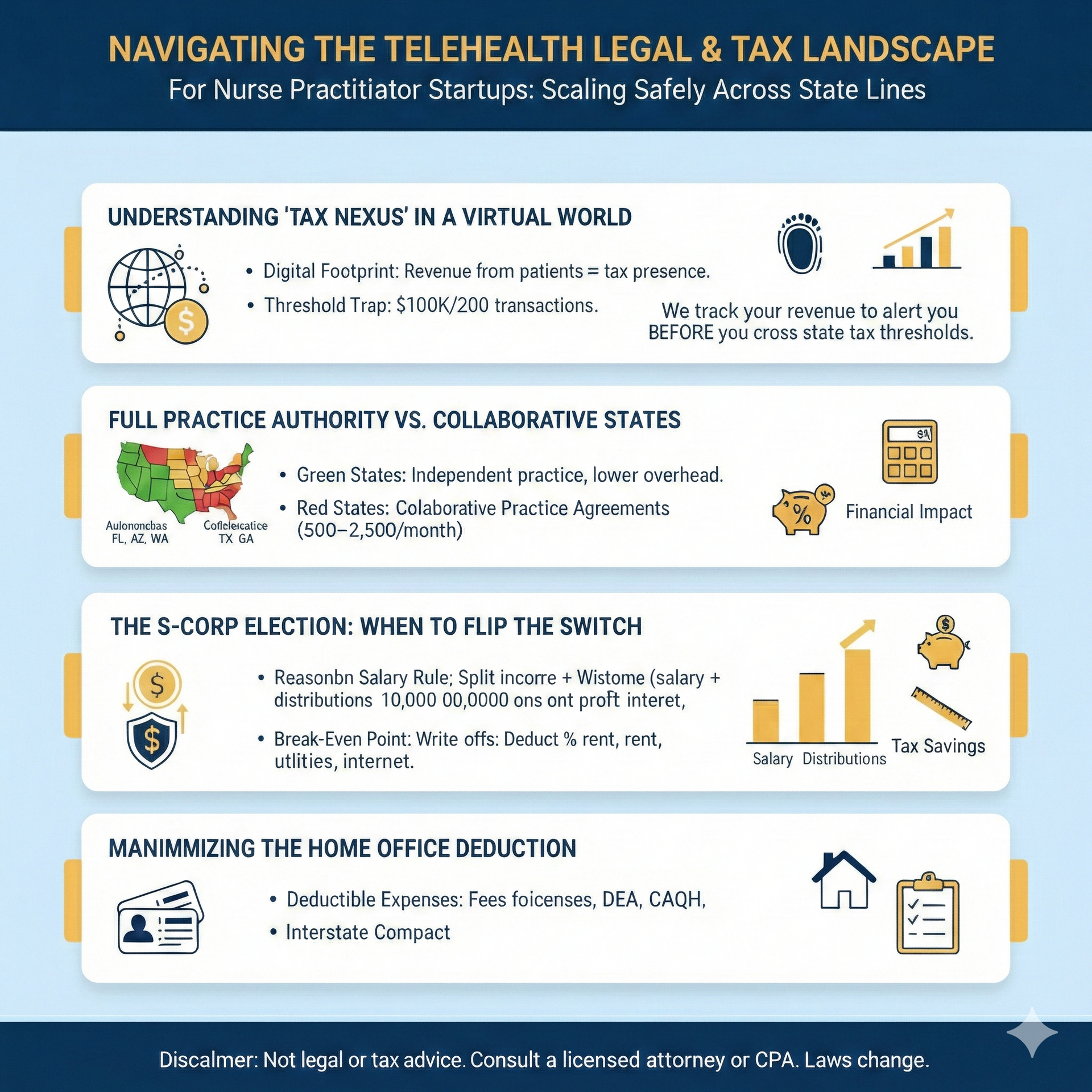
- The "Digital Footprint": If your telehealth practice generates revenue from patients in a specific state, that state may claim you owe them income tax, even if you never set foot there.
- The Threshold Trap: Many states have revenue thresholds (e.g., $100,000 in sales or 200 transactions). Once you cross that line, you are legally required to file a tax return in that state.
- How We Help: We use your
OptiMantra and
Fiserv data to track exactly where your revenue is coming from. We alert you before you hit these thresholds so your CPA can plan accordingly.
Full Practice Authority vs. Collaborative States
The "cost of doing business" varies wildly depending on a state’s scope-of-practice laws.
- Autonomous States (Green States): In states like Florida, Arizona, and Washington, you can practice and prescribe independently. This means lower overhead because you don't have to pay a collaborating physician.
- Collaborative States (Yellow/Red States): In states like Texas or Georgia, you may still be required to have a "Collaborative Practice Agreement" (CPA) with a physician.
- The Financial Impact: Collaborative fees can range from $500 to $2,500 per month. We help you factor these "hidden costs" into your budget when deciding which states to target for your 1099 or private-pay services.
The S-Corp Election: When to Flip the Switch
As your private-pay panel grows, you will eventually reach a point where a standard PLLC results in "Self-Employment Tax" overkill. This is where the S-Corp Election becomes your best friend.
- The "Reasonable Salary" Rule: The IRS allows S-Corp owners to split their income into two parts: a "Reasonable Salary" (taxed for Social Security and Medicare) and "Distributions" (not subject to self-employment tax).
- The Break-Even Point: For most NPs, the tax savings of an S-Corp start to outweigh the extra bookkeeping costs once your net profit hits $80,000 to $100,000 annually.
- Compliance is Key: You cannot just "pay yourself whatever." We help you document your salary justification to avoid IRS audits and ensure your Fiserv deposits are categorized correctly for your year-end 1120-S filing.
Maximizing the Home Office Deduction
Since your practice is virtual, your home is likely your "Principal Place of Business." This opens the door to significant tax write-offs that most clinic employees miss out on.
- Exclusive Use: To qualify, your home office must be used exclusively for business. That corner of the guest room counts; your dining room table does not.
- Proportional Write-offs: You can deduct a percentage of your rent/mortgage, utilities, internet, and even home insurance based on the square footage of your office.
- The Tekkadan Approach: We help you track these expenses throughout the year so you don't have to scramble for receipts every April.
Managing Multi-State Licensure Costs
Holding licenses in multiple states is a massive asset, but the fees add up.
- Deductible Expenses: Every dollar you spend on state licensing boards, CAQH maintenance, and DEA renewals is a fully deductible business expense.
- The Interstate Compact: We help you navigate the APRN Compact and other cross-state licensing tools to minimize the administrative burden of being a multi-state provider.
Frequently Asked Questions (The Telehealth Startup FAQ)
Transitioning from a salaried clinical role to an independent telehealth practice is an exciting move, but it naturally comes with questions. At Tekkadan Financial Solutions, we believe that clarity is the antidote to fear. Below are the most common questions we hear from Nurse Practitioners as they navigate the "Clinician-to-CEO" transition.
Disclaimer: I am not a lawyer or a CPA. The following answers are based on industry trends, deep market research, and our personal experience in the telehealth space. Always consult with a licensed legal professional and a tax advisor (CPA) before making final decisions on your business structure or financial strategy.
Can I keep my W2 clinic job while I build my telehealth practice?
Absolutely. In fact, many lenders—including our Funding Partners—actually prefer it. Having a steady W2 income shows banks that you have a "safety net," making you a lower-risk borrower for business credit. Most of our clients start their private-pay practice as a "side-hustle," seeing 5–10 patients a week in the evenings or on weekends until their private panel is large enough to support them full-time.
I have significant student loan debt. Will that stop me from getting business funding?
Not necessarily. This is a common myth. Lenders look at your Debt-to-Income (DTI) ratio, but business credit lines (especially 0% interest cards) are often approved based on your credit score and the strength of your business profile rather than your total student loan balance. With the average graduate nurse carrying significant debt, banks understand that education debt is a standard part of a medical professional's profile.
Do I really need a PLLC, or is a regular LLC enough?
In states like Florida, a PLLC is often the gold standard. While a standard LLC is fine for many businesses, a Professional Limited Liability Company (PLLC) is specifically designed for licensed medical professionals. It signals to banks, patients, and the Board of Nursing that you are operating as a legitimate medical entity. We recommend a PLLC for the added credibility it provides when applying for high-limit business credit.
What is the "Magic Number" for switching to an S-Corp?
Usu,ally when your net profit hits $75k–$100k. Running an S-Corp requires more "administrative muscle"—you have to run payroll for yourself and file a separate business tax return (Form 1120-S). However, the tax savings on Sthe self-employmentelf-Employment tax can be thousands of dollars once you reach this threshold. We help you track your profit in real-time so you know exactly when to ask your CPA to "flip the switch."
Why can't I just use a standard bookkeeper for my medical practice?
Because of HIPAA. A standard bookkeeper is not legally allowed to see patient-identifiable data on your bank statements without a Business Associate Agreement (BAA). If they do, you are the one at risk of a HIPAA violation. At Tekkadan, we sign a BAA with every client, providing you with a legal "shield" that a generalist bookkeeper simply cannot offer.
How much does it actually cost to start a virtual clinic?
A lean telehealth practice can be started for $5,000 to $15,000. * The "Smart" Stack: By using affordable, month-to-month tools like OptiMantra, Spruce Health, and Fiserv, you avoid heavy upfront software costs.
- The Capital Gap: This is why we help you secure 0% APR funding. It allows you to cover these startup costs and inventory without touching your personal savings.
I’m not "tech-savvy." Is setting up a virtual office difficult?
Not if you have the right partners. You don’t need to be a developer. Most modern platforms handle the heavy backend lifting. Our role at Tekkadan is to help you with the Digital Visibility side—setting up your Zocdoc profile, your Google Business listing, and your professional Outlook email so you look like an established practice from day one.
Do I need a separate "Type 2" NPI even if I don’t plan on taking insurance?
Yes. While your Type 1 NPI is tied to you as an individual, a Type 2 (Organizational) NPI is what separates your personal identity from your business entity. Lenders often look for a Type 2 NPI as proof that you are operating as a legitimate medical group. Furthermore, most HIPAA-compliant merchant processors, like Fiserv, and laboratories will require a Type 2 NPI to set up your professional accounts.
Do I need a separate DEA license for every state where I treat patients?
While the DEA has issued a "bridge" extension through the end of 2026 that allows for some cross-state flexibility, the Ryan Haight Act and the looms of the new "Special Registration" rules mean that the gold standard is having a DEA registration in every state where you prescribe controlled substances.
How do I set up a Google Business Profile without showing my home address?
You definitely want the visibility of a Google listing, but as an NP working from home, privacy is your #1 priority. The correct way to do this is to set up your profile as a Service Area Business (SAB).
- The Verification: You use your home address to receive the verification postcard from Google.
- The Privacy Setting: In the "Business Location" settings, you select "No" when asked if you have a location customers can visit.
- The Service Area: You then define the cities, counties, or entire states you serve. This allows you to show up in local searches for "Telehealth Weight Loss" or "Virtual PMHNP" without a red pin ever appearing on your actual house.
What is the "Telemedicine Cliff" I keep hearing about in 2026?
This refers to the expiration of the temporary rules that allowed for prescribing without an in-person visit. Because the DEA and HHS have extended these flexibilities through December 31, 2026, the "cliff" has been pushed back. However, the DEA is currently finalizing a permanent Special Registration for Telemedicine.
Can I share an EHR or HIPAA-compliant phone line with another NP to save money?
This is a common "startup hack" discussed on Reddit, but it is a massive legal risk. Most EHR and communication platforms (like Spruce Health) require a separate user license for every provider to maintain a clean audit trail. From a bookkeeping perspective, sharing a "subscription" makes it nearly impossible to untangle business expenses if you ever decide to split. We recommend staying lean but keeping your "Digital Identity" completely separate to maintain your business "Fundability."
What happens if my patient travels to a different state for vacation?
This is the "vacation trap." Generally, the law states that you must be licensed in the state where the patient is physically located at the time of the call. If your patient is on a one-week trip to a state where you aren't licensed, you technically cannot treat them. We help you set up automated intake reminders that ask for the patient's current location at the start of every session to keep your practice compliant.
Do I have to pay "Sales Tax" on telehealth visits or weight loss medications?
This depends entirely on your state. Most medical services are exempt from sales tax, but the sale of products (like supplements or compounded medications shipped to a patient) might not be. This is why having a specialized bookkeeper is vital. We help you track these transactions so your CPA can determine if you need to collect and remit sales tax in specific jurisdictions.
Can I use "Artificial Intelligence" to help with my charting?
AI scribes are exploding in popularity in 2026. While they save hours of time, you must ensure the AI tool will sign a Business Associate Agreement (BAA). If the AI "learns" from your patient data without a BAA, you are in violation of HIPAA. We recommend only using AI tools that integrate directly with your chosen EHR to keep your data stream secure.
Do I need a "Medical Director" if I am in a Collaborative state?
If you aren't in a "Full Practice Authority" state, you will likely need a Collaborating Physician. The cost for this is a major "overhead" item. We help you analyze the cost-benefit of paying a collaborator versus only marketing your services in states where you have Autonomous Practice authority.
What is the best way to handle "Refund Requests" for Weight Loss Meds?
Medical weight loss inventory is expensive. If a patient experiences side effects and wants a refund for the medication, your business can take a huge hit. We help you draft "Informed Consent" and "No Refund" policies for your digital intake so that once a medication is dispensed, your revenue is protected.
Can I be a "Digital Nomad" and run my practice from another country?
You can, but it is complicated. You must ensure your EHR and Merchant Processor allow logins from foreign IP addresses. More importantly, you must maintain a legal "Place of Business" in the U.S. (usually your home address) for your DEA and NPI registrations. We help you manage the tax implications of being a "U.S. based business" while you are traveling.U.S.-based
Ready to Reclaim Your Autonomy and Build a Bankable Practice?
The path from being an overworked clinician to a thriving Telehealth CEO is rarely a straight line. It’s filled with technical hurdles, "financial fog," and the constant pressure of maintaining compliance. But you don’t have to navigate it alone.
At Tekkadan Financial Solutions, we don't just provide "services"—we provide the Financial Engine that allows you to practice medicine on your own terms. Whether you are a PMHNP looking to open a private-pay mental health suite or an FNP launching a metabolic health clinic, we handle the "money side" so you can focus on the "patient side."
The Tekkadan Promise: Built in the Trenches
I didn't learn about these hurdles from a textbook. I learned them by sitting at the table with my wife, researching the best EHRs like OptiMantra, navigating the specific merchant requirements of Fiserv, and ensuring every single digital "brick" of her practice was HIPAA-compliant.
I’ve seen the transformation that happens when an NP moves from a high-volume clinic to their own Autonomous Practice. The mental fatigue disappears, replaced by the excitement of building something that is truly yours. My wife’s success isn't just a personal win—it’s the "Proof of Concept" for everything we do at Tekkadan.
Your Journey Starts with a Single Step
If you are ready to stop trading your health for a hospital salary and start building a legacy, let’s talk. We have the roadmap, the funding partnerships, and the technical expertise to turn your clinical skills into a profitable, independent business.
How to Get Started Today:
- Secure Your Capital: Don’t wait for "someday." See how much startup funding you qualify for right now through our elite 0% APR Funding Bridge.
- Book Your Free Strategy Session: Let’s sit down (virtually) and look at your specific niche, your "unit economics," and your roadmap to the "NP Freedom" exit.
- Protect Your Future: We will sign a BAA on Day 1, ensuring your practice is built on a foundation of legal and financial integrity.
Get a Free Telehealth Business Strategy Consultation
Why Nurse Practitioners Choose Tekkadan Financial Solutions
Built by an NP Spouse, Designed for Telehealth Founders
Generic accounting firms don't understand the "Clinical Squeeze." We do. Because I am an NP spouse, I’ve seen the transition from hospital burnout to autonomous practice firsthand. We don’t just provide "accounting help"; we provide a roadmap for the Clinician-to-CEO transition. Our expertise in PLLC structuring and NPI Type 2 requirements means we solve problems before they start, allowing you to practice at the top of your license.
Fractional CFO Strategy Without the Hospital Overhead
You shouldn't have to be a math expert to run a profitable clinic. We provide Fractional CFO services specifically focused on telehealth unit economics. We help you master the "Inventory Float" for expensive GLP-1 medications and calculate your Patient Acquisition Cost (PAC). You get executive-level financial leadership to scale your PMHNP or Weight Loss practice at a fraction of the cost of a full-time hire.
The Modern Telehealth Tech Stack (HIPAA-First)
We don’t just "use software"; we integrate the specific tools that keep your practice compliant and fast. From setting up OptiMantra and Spruce Health to securing affordable merchant processing through Fiserv, we handle the technical heavy lifting. We ensure every piece of your tech stack is protected by a Business Associate Agreement (BAA), so your financial data is as secure as your patient records.
Central Florida Roots, Borderless Telehealth Vision
Based in Central Florida, we provide the personal touch of a local partner with the technical capability of a national firm. Whether you are treating patients in Orlando or scaling your practice across state lines via Tax Nexus strategy, we are your boots-on-the-ground partners. We combine local market trust with the professional standards required to help you secure high-limit business funding from Tier-1 banks.
Real Success Stories: Helping Clinicians Become Owners
The "Launchpad" Success: Primary Pathway Health
"My wife is a Nurse Practitioner who wanted to start her own clinic, Primary Pathway Health. She bought a course, but it didn't give her the tools to actually open. I stepped in to handle the 'Setup Headache.' I set up her PLLC, got her Group NPI (Type 2), and picked her HIPAA-safe software. I also put her on Zocdoc, Healthgrades, and Doximity so patients could find her. She is launching next weekend and is ready to grow!"
— Primary Pathway Health PLLC
Orlando, FL
Zero Percent Funding Success: New Telehealth Startup
"I wanted to start a weight loss clinic but didn't want to use my own savings. Tekkadan helped me with Business Funding Advisory. They showed me how to get 0% APR business credit to buy my first round of inventory. They also set up my business bank account and merchant processing the right way so I didn't get flagged. They are true partners for any NP who wants to start a business."
— Family Nurse Practitioner (FNP)
Winter Park, FL
From "Ghost Clinic" to More Patients: Telehealth Psych NP
"I already had my telehealth psych practice running, but I was struggling to find patients. Tekkadan Financial helped me review my website and fix my online business profiles. They made sure I showed up where cash-paying patients were looking. Now, my practice is easier to find, and I finally have the growth I was looking for. They understood the technical side that other bookkeepers just didn't get."
— Psychiatric Nurse Practitioner (PMHNP)
Kissimmee, FL
The "In-Person" Setup: Private Medical Doctor (MD)
"Starting an in-person clinic felt overwhelming. Tekkadan handled the backend tasks that I didn't have time for. They helped me find startup funding, set up my HIPAA-safe business email, and recommended the best EHR (Medical Charts) for my needs. They made the move from hospital employee to clinic owner smooth and simple. I couldn't have set up my office this fast without their help."
— Medical Doctor (MD)
Lake Mary, FL